
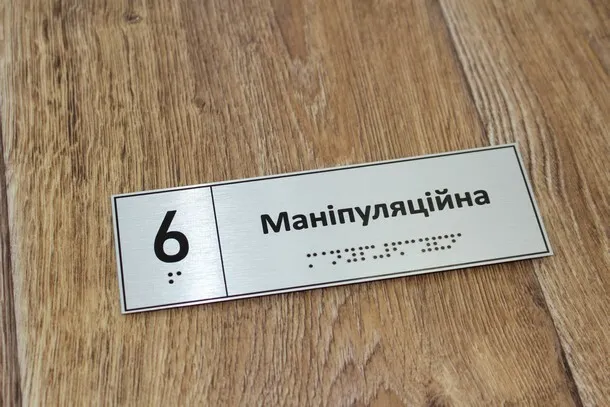
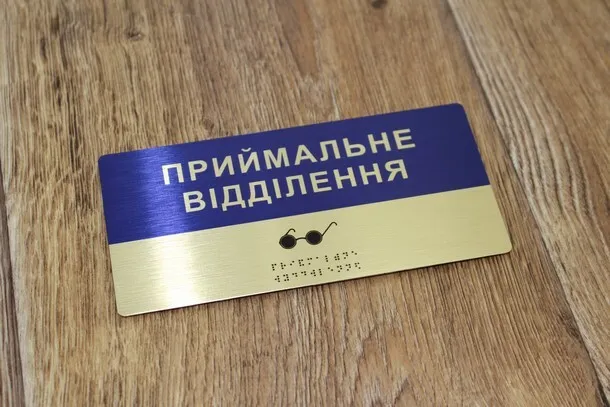
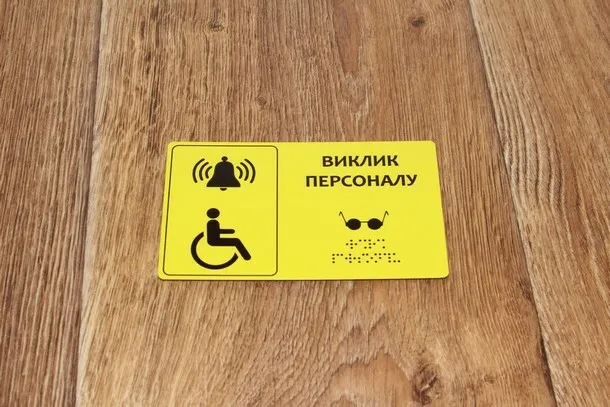
**Tactile plates with Braille** owe their existence, as one might guess from the name, to a citizen of France — Louis Braille, who lost his sight due to an accident that occurred in his youth in his father's cobbler workshop.
Trying to solve the problem of conveying printed information to blind citizens, Louis Braille was inspired by a military development of another French citizen — Charles Barbier, which involved the use of a raised-dot font for reading military dispatches at night without the use of any light source.
**Tactile Braille plates** are based on the binary information encoding system, which consists of alternating 0s and 1s, and on which absolutely all modern programming languages are based.
Today, with the increasing global attention to human rights, **Braille plates** have become a "must-have" attribute for any self-respecting public establishment in European Union countries.
Ukraine also has government programs designed to facilitate the integration of people with disabilities into society, including citizens with visual impairments. Within this program, **tactile Braille plates** have become widely used, allowing blind or visually impaired individuals to access previously inaccessible information through touch. **Braille plates for the blind** are often used for navigation of visually impaired people in public establishments.
**The production of tactile Braille plates** is one of the core areas of activity of our manufacturing company "Shilda.com," which is why we can guarantee the quality of our products and their compliance with all standards approved in state regulations for the visually impaired.